A new cause, new format: Legal Aid fundraiser Freed to Run returns to Jacksonville
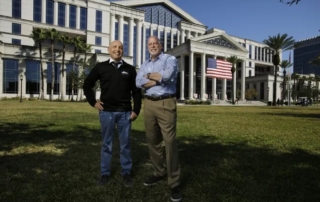
Attorney Mike Freed (left) founder of the Freed to Run fundraiser for Jacksonville Area Legal Aid, and Jim Kowalski, president/CEO of
Local philanthropist Delores Barr Weaver has offered a multi-year challenge grant to encourage donations to the Nov. 17-18 Freed to Run Challenge, the proceeds of which will benefit Jacksonville Area Legal Aid’s Shelter for Elders endowment to fund legal aid for area seniors facing housing instability. The Delores Barr Weaver Legacy Fund will match $25,000 in donations to the 2023 Freed to Run Challenge, provided the event raises at least $75,000 from other donors. In addition, over the following two years, the fund will match a gift of up to $25,000 from a single donor each year, dollar-for-dollar, provided that at least $50,000 can be raised from additional donors. The challenge grant is designed to help the Freed to Run Challenge meet its $100,000 fundraising goal each year. Weaver, former co-majority owner of the Jacksonville Jaguars, has a history of raising funds through running that goes back to 1990, when she offered a dollar-for-dollar matching challenge grant of up to $50,000 to a group of runners who would compete in the Boston Marathon. All the funds raised would go to the Claudia Adams Barr Program in Innovative Basic Cancer Research, which Weaver had established in 1987 at the Dana-Farber Cancer Institute in memory of her mother, Claudie Adams Barr, who died of breast cancer.
“Cleota Brown” had worked part-time for a local media outlet for more than 20 years when she was hired full-time to work as an administrative assistant in the human resources department. In that position, she and another employee sometimes covered each other’s duties when one or the other was out. During a casual conversation at work, the other employee mentioned that she received overtime pay when covering for Cleota. This came as a surprise to Cleota because she had been told by their supervisor that when one employee covered the duties of another, it had to be done during regular work hours. With encouragement from her colleague, Cleota raised the issue of disparate pay with her supervisor. Rather than acknowledging the unequal treatment, the supervisor accused Cleota of discussing “confidential pay information” and said this was a violation of the law and company policy. The supervisor then ordered Cleota to attend a meeting the next morning. At that meeting, Cleota tried to hand her supervisor a summary of the National Labor Relations Act (NLRA)’s guidance as to an Unfair Labor Practice. The supervisor refused to look at this handout and instead threatened Cleota with termination.
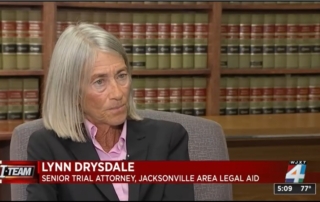
Could your old debt come back to haunt you? A man who used to live in Duval County said “zombie debt” appeared in his life seemingly out of nowhere. Justin Purser said a debt of a few thousand dollars from close to 20 years ago had ballooned with interest to more than $11,000 when a debt collector came knocking for the first time in 2021. An attorney at Jacksonville Area Legal Aid said they see “zombie debt” cases locally every week, and with the pandemic putting other types of debt collection on hold, like for mortgages and student loans, some collectors began resurrecting debt consumers might have thought was dead and buried. “Honestly, I thought it was a joke,” Purser told the I-TEAM of his reaction to a notice in 2021 of an $11,000 debt from 2004. “I was never never notified that I had any debt. Like, how is this possible? So I thought it was a joke, but unfortunately, it wasn’t,” he said. Court records show a judgment against him in 2004 for a debt of about $2,800, and with attorneys’ fees, interest, and other costs, the total came to nearly $4,900.
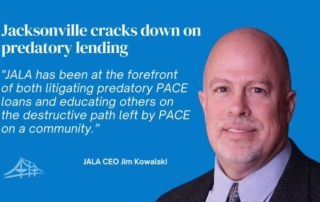
Mayor Donna Deegan praised City Council's approval Tuesday of legislation that opens the way for a lawsuit against Florida PACE Funding Agency to stop it from financing home improvements on residential property without the city's authorization. “I want to thank Council President [Ron] Salem and the entire City Council for swiftly and unanimously passing this important legislation that will save citizens from financial ruin,” Deegan said after the council unanimously approved Salem's bill. “I urge everyone in Jacksonville to tell their neighbors about these predatory loans so that another family isn’t hurt by this damaging practice.” Florida PACE Funding Agency is a special government district authorized by state law to provide financing for the installation of improvements that will make buildings more energy-efficient and resistant to hurricane-force winds.
At least 160 Jacksonville homeowners this year have participated in what officials are calling a “predatory” home-improvement loan program. But this week, the Jacksonville City Council took steps to stop that loan program from doing any further business in the city. Officials also are making strides to help the property owners who have already taken out the loans that, in some cases, threaten to raise the homeowner’s tax bill by 1,000% and possibly risk their homeownership. The Property Assessed Clean Energy loan program — also known as PACE — began in Florida in the city of Kissimmee and Flagler County as a way to allow property owners to make upgrades to their house for zero down payment and full financing. The Florida PACE Funding Agency — special districts created under state law to administer the program — is in charge of the loans. But the program is exempt from the federal Truth in Lending Act, which requires lenders to make sure borrowers can knowledgably pay back loans. The program also is a tangle of public and private entities, third-party firms, contractors and salespeople, according to a Tampa Bay Times report on the lack of oversight.
Mayor Deegan is announcing her appointment of Michael Fackler to become the City of Jacksonville’s next General Counsel. A long-time commercial litigator, Michael Fackler has practiced law for nearly 20 years and is a partner at the established local law firm of Milam Howard Nicandri & Gillam P.A. Previously, he was a law clerk for the Honorable Harvey E. Schlesinger, United States District Court Judge for the Middle District of Florida. Mr. Fackler has also served as the Jacksonville Federal Bar Association President and as an Adjunct Professor at Florida Coastal School of Law. He has been honored as a “Super Lawyer” since 2016 and as part of the “Florida Legal Elite” in 2012, 2020, and 2021. Outside of the legal arena, Mr. Fackler has a deep connection to the community. He is a current board member for the Jacksonville Area Legal Aid and Riverside Presbyterian Church Basketball League. He has also served as a board member, President, Vice President, and Treasurer of the Jacksonville Historical Society. From 1996 to 1998, Mr. Fackler served in the United States Peace Corps in Rybnik, Poland. Afterwards, he served as a board member and President of the First Coast Returned Peace Corps Volunteers.
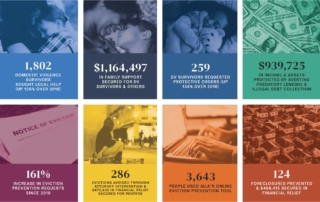
Fifty years after adopting its current name, Jacksonville Area Legal Aid is updating its branding with the release of its 2022 annual report, the first document to bear JALA’s new logo. Titled “Housing Takes Center Stage,” the report shines a spotlight on JALA’s work to prevent unlawful evictions and foreclosures, ensure fair housing laws are enforced, and resolve other landlord-tenant issues. Out of 6,724 cases JALA handled in 2022, JALA closed 2,618 housing cases, representing nearly 40% of its closed cases. “Preserving shelter is our highest and best use, and we remain focused on that mission,” the report states. JALA’s annual report also cites a recent report by the City of Jacksonville’s Special Committee on Critical Quality of Life Issues, which states that, “The City should work with and financially support the Jacksonville Area Legal Aid office in efforts to reduce eviction rates, human displacement and homelessness.”
Since June, the US Department of Housing and Urban Development (HUD) has inspected at least 1,200 HUD-subsidized properties, agency data shows. But thousands of inspections are overdue, despite agency goals to eliminate the backlog in spring of this year. For public housing owned by housing authorities and privately owned multifamily housing that receives HUD funding, the agency relies on inspections to hold landlords accountable for unaddressed safety hazards. Last month, Streetlight reported that longstanding problems with the inspection program and HUD’s oversight place renters’ lives at risk. Since then, HUD’s inspections and oversight of the properties it subsidizes have drawn attention from Republican Sen. Marco Rubio, who urged HUD to ensure gas leak repairs were made at a Florida apartment complex at the beginning of August.
The city’s Military Affairs and Veterans Department and Jacksonville Area Legal Aid are offering free Ask-A-Lawyer sessions. Beginning Aug. 17, the events will be 9 a.m. to noon the third Thursday of each month in the department’s office suite at City Hall, 117 W. Duval St. Topics include family law; housing, including landlord/tenant; probate and estates; contracts; consumer law, including debt and credit reporting; veterans benefits; military discharge upgrades; and security clearance defense. Participating attorneys will not be accepting cases for representation, but will offer legal guidance and information about available resources. Call 904-255-5550 to schedule an appointment.