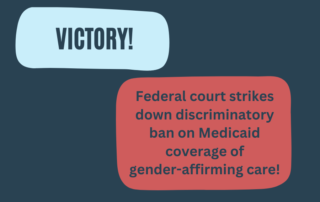
Victory for Gender-Affirming Care
“JALA recognizes and salutes the astonishing legal work by Florida Health Justice Project and its partners in this case. Their advocacy, and


“JALA recognizes and salutes the astonishing legal work by Florida Health Justice Project and its partners in this case. Their advocacy, and
The Yulee News considers it important to bring to its readers the many organizations whose services are available to them. We spoke with Jim Kowalski Jr., Esq. who is the President and CEO of Jacksonville Area Legal Aid (JALA). Nassau County is one of the 17 counties that are covered by JALA in North Florida. JALA is the oldest legal aid firm in Florida founded in 1937 as a pro-bono outreach of the Jacksonville Bar Association. Through the years it has become a more formal legal aid organization through the process of hiring attorneys and staff. Currently, there are 40 lawyers and staff making it the 8th largest civil law firm in Northeast Florida. The mission of JALA is, “A nonprofit civil legal aid firm focusing on delivering economic, social, and housing justice to low-income and at-risk individuals and families on the First Coast.”
“Gregory,” a veteran who is completely disabled from multiple strokes, was about to lose his home to foreclosure after months spent in a hospital and rehabilitation center during his recovery. Unable to leave his home, he is dependent on his daughter's care and that of two home health nurses. Gregory’s daughter set up automatic payments of his mortgage because of his health challenges. When the monthly payment increased without notice, the payments started being returned, and he found himself in foreclosure.
“Alice,” a single mother with two children, was facing foreclosure on her home over unpaid homeowner’s association dues. She applied for assistance from JALA five days before a scheduled summary judgment hearing. Joy Bryant-Baucum, a certified HUD counselor at JALA, began working on an application for financial assistance from the City of Jacksonville, while JALA staff attorney Michael J. Pelkowski began working on the foreclosure case. Pelkowski was able to prevent a judgment from being entered, providing Alice a brief window to pay what she owed the HOA.
Nease High School’s International Baccalaureate students will be holding the End Your Summer Off Right 5k from 7:30 a.m. to 9 a.m. July 29 to benefit St. Johns County Legal Aid, the St. Augustine office of Jacksonville Area Legal Aid. Register or donate at: www.jaxlegalaid.org/endyoursummer5k Sponsored by Nocatee, the event at 400 Nocatee Center Way in Ponte Vedra will raise funds and awareness for two of St. Johns County Legal Aid’s key domestic violence prevention initiatives: injunctions for protection and immigration petitions for abused spouses and trafficking victims. “We are so grateful to these students for supporting St. Johns County Legal Aid in this important work,” said Megan Wall, the managing attorney for the office. “We hope to see a lot of participation from throughout the community.”
Laura Boeckman and Katie Fackler has been appointed to The Florida Bar Foundation Board of Directors. Boeckman, assistant general counsel for the city of Jacksonville, was appointed by the Florida Supreme Court. Fackler, associate general counsel with Baptist Health System, was appointed by The Florida Bar Board of Governors. Boeckman will fill the remainder of a three-year term ending in 2024 that was vacated by another board member. She graduated from Indiana University School of Law in 2001 and began her career as a judicial clerk and a staff attorney with Jacksonville Area Legal Aid. She has since served as a clinical professor at Florida Coastal School of Law and as the North Florida Bureau Chief of the Consumer Protection Division of the Florida Office of the Attorney General.
Thelma Vo, 67, came to JALA after unsuccessfully disputing charges for dental services she had not been provided. She had X-rays done and was told she would need several crowns. She did not have insurance, so she paid out of pocket. That same day, she signed an agreement with a bank to finance any future dental services she might require. Vo decided to get a second opinion from an endodontist and, based on this second opinion, then called the dentist office to cancel any further appointments. She called the dental office repeatedly for weeks, never receiving a return call. In the meantime, she continued to be charged by the bank, which was auto-debiting her account in the amount of $164/month. Vo finally reached out directly to the lender to cancel her contract. She was told they would need to receive a cancellation report from the dentist before they could close out her account. The lender received a cancellation report, but it was not completed correctly by the dentist, so they did not act on it. By this time, $640 had been debited from Vo’s account, all for services she did not receive. The dentist never sent a corrected cancellation report to the lender, and the dentist argued that Vo did owe fees for a provisional crown it had ordered from its own lab. During the initial consult, Vo did not have any impressions done and was not provided with any documents regarding the cost of any additional services.
“Joseph,” who lives in federally subsidized housing, has had multiple strokes and is in on weekly dialysis. He is legally blind, cannot drive and needs an electric wheelchair to get around. Having a live-in aide would help him live more independently in a stable environment. His choice of live-in aide was denied by his property management company because of a “derogatory, negative, or insufficient credit report and for having a credit score of 519." Under HUD regulations, negative credit is not a permissible reason for denying a live-in aide for a person with a disability. The regulations provide that a live-in aide does not have to meet tenant eligibility requirements. The rationale is that a live-in aide is not a tenant and does not receive a housing subsidy, because the rent is not calculated based upon the live-in aide’s income. A live-in aide merely makes it possible for the elderly, near elderly, or disabled individual to benefit from the housing program.
JACKSONVILLE, Fla. – Attorney Jacalyn Crecelius, who leads Jacksonville Area Legal Aid’s Veterans Legal Services Unit, has received Veterans Administration accreditation, a qualification that helps ensure claimants have access to responsible and qualified representation on their VA benefits claims. “This accreditation opens up major opportunities to serve northeast Florida veterans and their families,” Crecelius said. “There are so many underserved veterans who aren’t receiving the VA benefits they deserve, and I’m excited to be able to advocate for them in a notoriously complicated system.” With accreditation, Crecelius can represent claimants after the VA has issued an initial decision on a claim. She can help them further develop evidence to support their claim and devise legal arguments on their behalf to submit to VA. She can also help clients navigate the VA appeals process. “JALA is thrilled to have a VA-accredited attorney to better serve our veterans,” JALA President and CEO Jim Kowalski said. “VA studies have found that civil legal assistance is among the top unmet needs of unhoused veterans, and the affordable housing crisis has only increased the challenges faced by our veterans. Access to veterans’ benefits is critical to providing all low-income veterans with stability.”
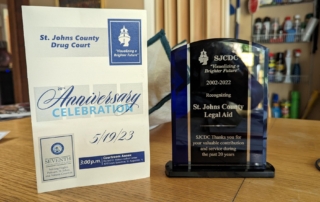
As part of its 20th Anniversary Celebration, St. Johns County Drug Court recently recognized St. Johns County Legal Aid for its service to the court, a judicially-led program for non-violent addicted people with drug-related felony charges who reside within the county. The program involves regular court appearances before the judge, substance abuse treatment counseling, frequent random drug testing and supervision by probation. Five years ago, the treatment courts in St. Johns County, which include the Drug Court as well as a Veterans Treatment Court, asked St. Johns County Legal Aid to join their court team. “The treatment court model was designed with prosecutors, public defenders, law enforcement, and probation officers, as well as therapeutic counselors for mental health and addiction treatments, but the team was missing the civil legal issues that were holding down their success rates,” said Megan Wall, St. Johns County Legal Aid managing attorney.